
Read Quitman County Property Tax Records
Two Quitman County offices share the tax work. The Tax Assessor estimates fair market value and maintains exemptions. It also publishes the county digest through qPublic and Beacon. The Tax Commissioner then issues tax bills, collects payments, and handles delinquency and tax sales. Follow the parcel across both. Start with the assessor's appraisal card. Then match it to the collector's tax bill by parcel number. Neither screen is a deed register, though. A recent transfer may show up in the Clerk of Superior Court's land records first. The assessor card only reflects the latest published digest.
| Field | What It Shows | Where |
|---|---|---|
| Fair market value | The assessor's estimate of full value | Tax Assessor |
| Assessed value | Forty percent of fair market value under Georgia law | Tax Assessor |
| Exemptions | Approved reductions used to reach net taxable value | Tax Assessor |
| Bill and status | Amount billed, payment, interest, or delinquency | Tax Commissioner |
| Tax execution | A recorded FiFa after the statutory collection steps | Commissioner and Superior Court docket |
Georgia law sets most taxable property at 40 percent of fair market value under O.C.G.A. §48-5-7. Exemptions shrink the net assessed amount. Millage then applies as dollars per $1,000 of that assessed figure. A recorded sale price is one number. The final tax bill is another. Keep the tax year beside every figure, because a value, an exemption, and a payment can each belong to a different cycle.
Two Quitman County Tax Counters
The Quitman County Tax Assessor sits at 111 Main Street, Suite 1, Georgetown. The office answers assessment-roll questions at 229-334-2159. The Tax Commissioner works from Suite 3 at the same address. That office takes bill questions at 229-334-9000. The shared hallway hides a legal split. Assessor staff cannot turn an appraisal record into proof of payment. Commissioner staff do not set market value.
The qPublic landing page notes that its figures are assessor values, not tax bills. If Beacon will not load, email quit.app@gqc-ga.org or quitcotax@gqc-ga.org, call, or visit the assessor. For bills, delinquent balances, or tax sales, email quit.taxcomm@gqc-ga.org. Confirm the bill number and amount. Georgia's Open Records Act also backs a written request. It covers any card, digest entry, or tax-sale record.
Quitman County's 40% Assessment Level
Fair market value and assessed value are not the same thing. Georgia defines fair market value as what a knowledgeable buyer would pay a willing seller in an arm's-length deal. The statutory assessment level is 40 percent for most taxable property. So assessed value is a tax-base figure drawn from the assessor's market estimate. It does not predict the next sale price.
A Quitman County property tax record may also break out land and improvement values, list exemptions, and show a net taxable figure. Read the labels on the current card. Save a copy with its tax year. Do not borrow column names from another county's Beacon screen, because Quitman County's own display governs.
Look Up Quitman County Property Tax
Begin at the official Quitman qPublic page rather than a third-party tax estimate. It links to both the Beacon property search and the tax-estimate application. Use only the choices the live form offers. Fields can vary. Address, owner, and parcel number are the standard search options. The parcel number is usually the cleanest bridge. It ties the assessor card to the Tax Commissioner's bill.
- Search the qPublic/Beacon record by the current street address. Copy the parcel or alternate ID exactly as displayed.
- Record the fair market, assessed, exemption, and net taxable figures with the digest year.
- Contact the Tax Commissioner with the parcel ID and address. Confirm the bill number, balance, and payment status.
- If delinquency appears, ask whether a FiFa has been recorded or levy and tax-sale action has begun.
- Assessed value
- The statutory share of fair market value used as the tax base.
- Millage
- Dollars charged for each $1,000 of assessed value.
- Homestead exemption
- Tax relief that may reduce taxable value for an eligible primary home.
- Tax execution or FiFa
- A public claim recorded after unpaid property tax reaches the collection stage.
Property statements go out by September 15. Quitman County taxes are due November 15, and interest accrues after that date under local guidance. Call before paying online. The county asks payers to verify the bill number and amount, and card processing carries a fee.
Quitman County Homestead Tax Relief
An exemption lowers taxable value. It does not touch the deed or the fair market estimate. The local homestead page lays out the standard route. It also lists age and income-based categories that Quitman County recognizes. Filing generally runs January 1 through April 1. Approved exemptions often renew on their own. But a move, a deed change, or a shift in eligibility usually means filing again or notifying the office.
Check the assessor card for the year at issue to see which exemptions were applied. If a benefit seems missing, call the Tax Assessor instead of adjusting the bill yourself. Bring the parcel ID plus whatever ownership and occupancy documents the office asks for. Remember the split in duties. The Tax Commissioner calculates and collects from the certified digest, while exemption eligibility stays with the assessor.
Quitman County Delinquent Tax Trail
A missed due date does not end the story in Quitman County. Interest adds up monthly at the prime rate plus three points, annualized. Then a five percent penalty starts at 120 days. Five percent more is added each 120 days. The total can reach twenty percent of the original principal. These deadlines move fast. Ask the Tax Commissioner for a current payoff rather than trusting an old bill.
A 30-day intent-to-levy notice comes first. Then a tax execution, called a FiFa, comes next. It can be recorded on the Superior Court General Execution Docket. That docket entry stays public for seven years, per the local FAQ. Once levy or sale action begins, the office wants payment in person. The Clerk can confirm a FiFa. But only the collector gives the payoff and sale status.
Quitman County Five-Year Tax Context
A single millage rate tells you little without its history. The consolidated government's 2024 news archive collects five years of tax history, millage notices, public hearings, and property-tax increase notices in one place. Each notice shows when a proposal was published and when the public could respond, so match every item to the tax year on the parcel card.
Commission minutes fill in another piece: land changes that later reach the digest. The 2025 Tanglewood Trail proceedings, for instance, moved a 14-acre tract from A-1 to R-1 and approved a preliminary plat for 12 parcels. Planning approval alone sets no value. But the parcel split and any improvements that follow can shape later assessment records, and the trail is easy to trace from minutes and plat to new parcel cards to bills.
Challenge a Quitman County Tax Assessment
An appeal targets value or another appealable assessment issue. It does not dispute collection of a correct bill. Georgia gives an owner 45 days from the date on the annual assessment notice. The PT-311A appeal form is the state route. The notice shows where to file locally. Name the property, tax year, grounds, and requested value. Keep proof of delivery.
Good evidence includes the parcel card, a recent survey, photographs, repair facts, and comparable sales. The recorded deed belongs in the file too. Keep assessed value apart from fair market value when framing the claim. The Board of Tax Assessors hears the matter first. Later routes depend on the election and decision in the case.
Appeal window. File within 45 days of the assessment notice date with the local Board of Tax Assessors, using the notice instructions.
Verify the form before filing. The official Georgia Department of Revenue PT-311A page displays the appeal form and its current instructions.
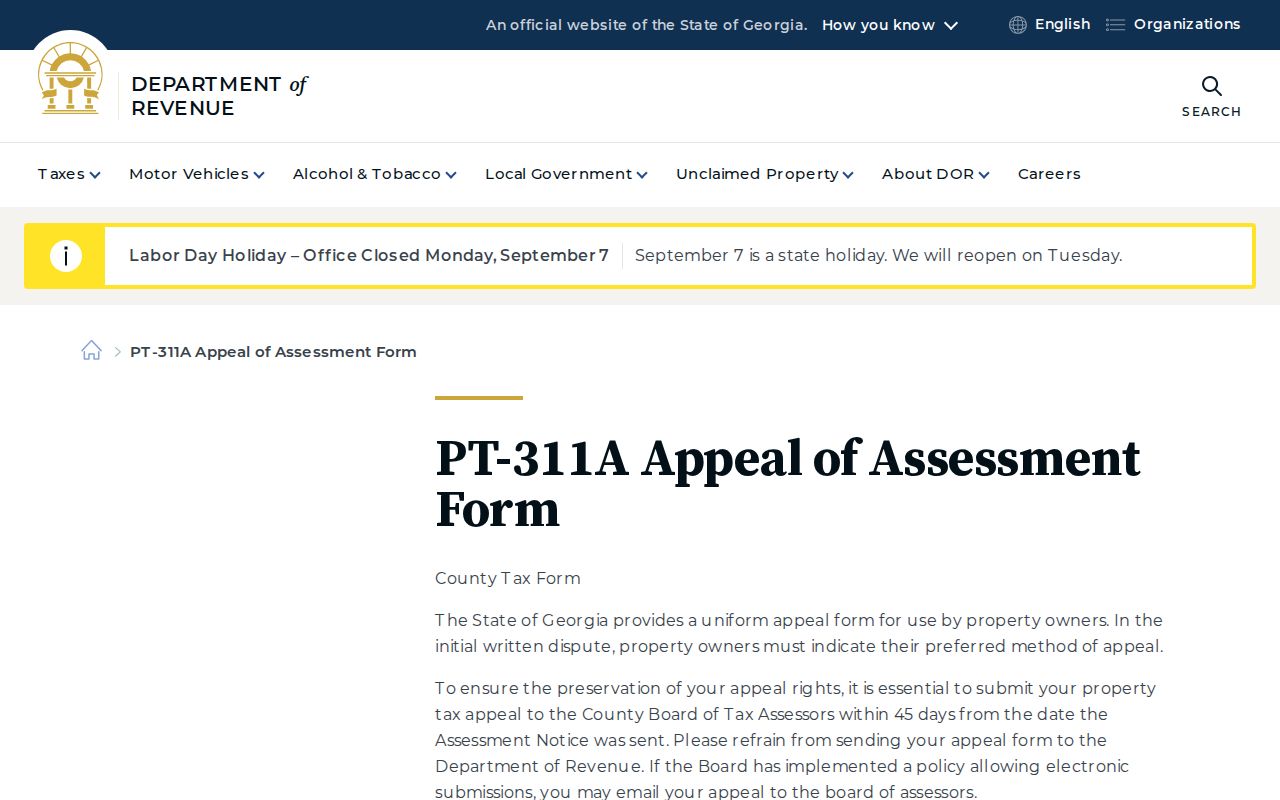
The state page stays current. It keeps the appeal path tied to the agency source, though the mailed assessment notice still controls local filing details and the deadline date.
Request Missing Quitman County Tax Records
Online access is only one channel. Visit or call the assessor for a parcel card, digest entry, or existing export. Ask the Tax Commissioner for a bill, payoff, delinquency, or tax-sale file. Old digests live in the Georgia Archives Virtual Vault. Give the address, parcel ID, tax year, and the exact record you need.
A written Georgia Open Records Act request usually draws a response, production schedule, cost estimate, or exemption explanation within three business days. The agency need not build a new spreadsheet. Ask for electronic copies. Confirm any labor or copy cost before work starts.
For valuation versus likely sale price, see the Quitman County property value explanation. Tax bills, exemptions, delinquencies, and appeals stay the focus here.