
What Quitman County Deed Records Convey
The Quitman County Clerk of Superior Court is the recorder for deeds, plats, security deeds, mortgages, liens, and UCC filings. Every title describes a distinct event or claimed interest in land.
| Deed Type | What It Does | Common Use |
|---|---|---|
| Warranty deed | Conveys the stated interest with covenants | Ordinary sale |
| Quitclaim deed | Conveys whatever interest the grantor holds | Family transfer or cleanup |
| Gift deed | Conveys an interest as a gift | Family or estate planning |
| Executor or trustee deed | Conveys through a fiduciary | Estate or trust |
| Tax deed | Documents a tax-sale transfer | Delinquent-tax proceeding |
Ownership passes through a conveyance deed. A security deed, mortgage, or lien only records an encumbrance against it, so search each instrument family separately and watch for later cancellations or releases.
Quitman's Grantor-Grantee Index
The GSCCCA Real Estate Index opens deed, lien, and plat dockets with several entry points: party name, county, book and page, property, geography, instrument type, and date. Choose Quitman County. Copy the exact reference a result gives you. The official GSCCCA real-estate index instructions explain how Georgia organizes these deed-search options.
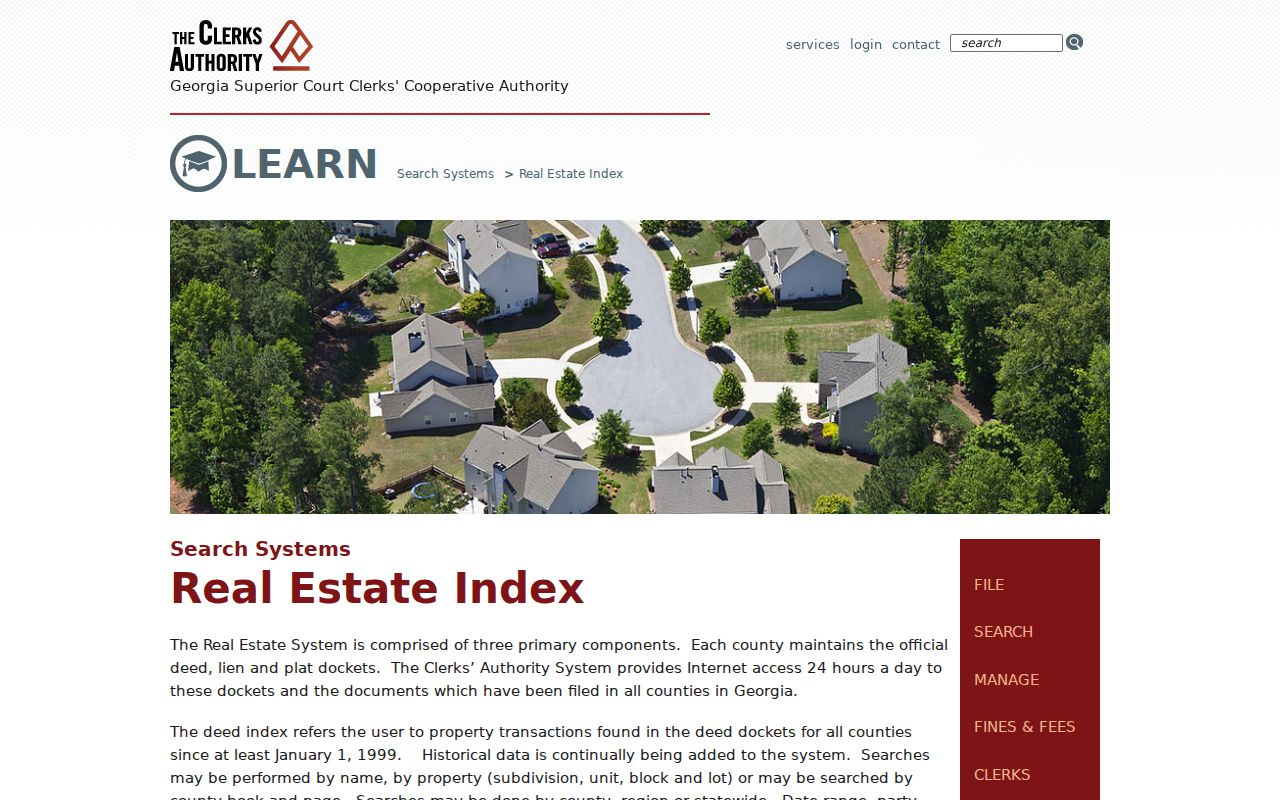
The screen is only the statewide framework. The county filter, party role, instrument type, and recording reference are what tie a Quitman County result to the deed you actually want.
- Find the current owner's acquisition deed with that party as grantee.
- Copy the grantor, date, type, book/page, and legal description.
- Search the grantor as an earlier grantee and verify the same tract.
- Repeat, moving to deed books when verified digital coverage ends.
- Grantor
- The party conveying the stated interest.
- Grantee
- The party receiving it.
- Chain of title
- The ordered sequence of instruments affecting one tract.
- Book/page or instrument number
- The durable locator for a recorded document.
Get a Quitman County Deed Copy
Use GSCCCA search for available online images or a Georgia Superior Court clerk terminal for full database access. For an unavailable image or certified copy, contact Clerk Becky Fendley at 229-334-2578 or P.O. Box 7, Georgetown, GA 39854 with party names, instrument type, date, and book/page. No official local copy fee was verified, so request current pricing before payment.
Recorded, not guaranteed. The index shows instruments accepted into the public record; it is not a title opinion and cannot resolve every unrecorded interest.
Historic Quitman Deed Books, 1879–1924
The Georgia Archives finding aid lists Mortgage and Deed Books 3–16 covering 1879 through 1924. It also lists Ordinary Minutes from 1864 through 1902. Book 15 spans 1919–1922 and carries an index. Treat the catalog metadata as a locator, not a parcel card. The parties, consideration, and legal description live in the image or microfilm itself.
Quitman Liens and Releases Require a Separate Search
Deeds are only half the picture. Search the GSCCCA lien docket too. Tax executions land on the Superior Court General Execution Docket, and local material says a tax FiFa stays public there for seven years after the delinquency process. A later release, a cancellation, or even a similarly named party can flip a result's meaning. Read the instrument instead of trusting the caption.
Use FANS for New Filing Alerts
The GSCCCA Filing Activity Notification System is the statewide fraud-alert route, and Quitman County offers no separate signup. Register useful name variants. Treat any alert as a reason to inspect the filing, not as proof of fraud.
Read the Recording Reference Before the Image
Transcribe the result row first. Write down the indexed party names and which side each is on, grantor or grantee. Add the instrument type, the execution and recording dates when both appear, the book and page or instrument number, the county, and the image-access status. Those fields build a citation you can reproduce. They matter when a session expires or the image exists only at a courthouse terminal.
| Party direction | Shows who conveyed and who received the stated interest. |
|---|---|
| Document type | Separates a conveyance from a security deed, lien, cancellation, plat, or corrective filing. |
| Recording reference | Lets the Clerk retrieve the same instrument without repeating a broad name search. |
| Legal description | Connects the deed to land lot, district, lot/block, subdivision, acreage, or metes-and-bounds language. |
| Image status | Indicates whether the next step is an online image, account access, terminal review, or copy request. |
The street address may be missing or may have changed. A book-and-page citation paired with the legal description is the steadier chain identifier.
Account Access and the Courthouse-Terminal Alternative
GSCCCA layers its access: public information pages, limited online search, premium search, and images. The premium real-estate route requires an account, and online image availability varies. Full database access waits at Georgia Superior Court clerk offices. That makes the courthouse terminal a real channel, not a last resort.
Prepare before visiting. List Quitman County first. Add every party-name variant, a realistic date span, and the likely instrument family. Include any parcel-card deed reference, too. At the terminal, run the deed, lien, and plat dockets separately. If you need a result to take home, ask what can be printed or certified and what fee applies.
Note: An online account gate never closes the public index itself. That index stays available through the Clerk's office.
Plats and Legal Descriptions Keep Quitman Deeds on the Same Land
Land changes shape over time. A Quitman County parcel may be split, combined, replatted, or redescribed as years pass, so a deed chain should be checked against the legal description every step of the way. Compare land lot and district numbers, subdivision and lot/block labels, acreage figures, metes-and-bounds calls, adjoining owners, and plat references as you move from deed to deed. The unified government's subdivision regulations tie final plats to approval and recording conditions, and the Clerk keeps the recorded plats themselves.
Watch for mismatches. When two Quitman County deeds disagree on acreage or use a different lot designation, stop and search the plat docket before going further, because the shift may come from a lawful reconfiguration rather than an indexing error. A GIS map can help you get oriented. Still, the deed and the recorded plat control.
Estate and Court Transfers Do Not Always Resemble Sales
Not every deed marks a sale. An executor, administrator, trustee, tax authority, or court officer can show up in a Quitman County deed chain, and the instrument behind the transfer often tells a different story than the index suggests. The Quitman Probate and Magistrate Court handles wills, estates, guardianships, and conservatorships, while Superior Court filings may hold quiet-title actions or other property litigation. Read the deed, then pull the underlying case when authority or sequence matters.
Deed type alone reveals nothing about price. Gift, executor, trustee, quitclaim, and tax deeds each carry their own circumstances, and an indexed caption is no substitute for the granting clause, legal description, reservations, and signatures on the instrument itself.
A Focused Written Request Gets Better Deed Results
A written request works best when it names a specific Quitman County record. Give the clerk every identifier you have. Include party names, the recording date range, instrument type, and any book/page or instrument number. Say plainly what copy you want. Choose an electronic copy, plain paper, or a certified copy for a deed record. Keep the ask narrow. The office retrieves identified instruments and runs index searches; it does not compile title reports or settle questions about the owner of record.
Georgia's Open Records Act guidance favors written requests for good reason. An agency normally responds within three business days. It can cite exemptions for anything withheld, and may bill lawful copy and direct costs. The first 15 minutes of search, retrieval, and redaction are free. Check the Clerk's current delivery and payment instructions before mailing any funds.
Address Variants Should Not Control a Quitman Deed Search
An address feels like the natural starting point for a property search. The deed chain rarely cooperates. Quitman County's own contact material lists Grove Street as Old School Road. It also lists Middle Street as US Highway 82. USPS moved Georgetown's delivery ZIP 31754 to 39854 on July 1, 2002. An older instrument may carry a vanished road label. It may instead carry a rural route, adjoining landowners, or no street address at all.
Let the assessor result fix the modern parcel number first. Then search Quitman County deed records by party name, book/page, land lot, district, acreage, subdivision lot, and metes-and-bounds calls. Treat the street aliases as discovery aids only. Once the right deed is open, its legal description controls the match. That matters far more than any address printed on a later tax bill.
Separate Index Evidence from Instrument Evidence
An index answers one question: where is the document? It may abbreviate a name. It may truncate a description, or sort an instrument into a broad category. The deed image itself carries the granting clause, reservations, exceptions, and signatures. It also holds acknowledgments, consideration, return address, and the full property description. So use the index to find. Use the deed to interpret. Bring in legal or title help when the answer affects a real transaction.
Corrections surface as later affidavits, corrective deeds, or re-recordings. When a book/page citation, acreage figure, or name collides with another source, search the same parties. Search them across the same recording window. A later document can explain the earlier record. It does so without erasing it from the public chain of deed records.
Keep a Reproducible Quitman Deed Search Log
Keep a search log you could hand to someone else. Record the search date and the Quitman County filter. Note each party spelling tried, the party role, instrument family, date range, and every book/page opened. When a result fails, jot down why. Was the legal description off? Did the date or party capacity not match? A short note keeps the same false lead from resurfacing. That matters as you move between GSCCCA, the Clerk's terminal, and the historical volumes.
For each confirmed link, save both the index citation and the instrument source. Transcribe names exactly as written, including trustee, executor, estate, or company capacity. Note where the image was read: online, at the courthouse, or on archival microfilm. If an image stayed out of reach, call the conclusion provisional. A careful log turns a name-based guess into a documented chain of deeds. It also gives the Clerk or Archives staff a precise question whenever the next volume or reference goes missing.